
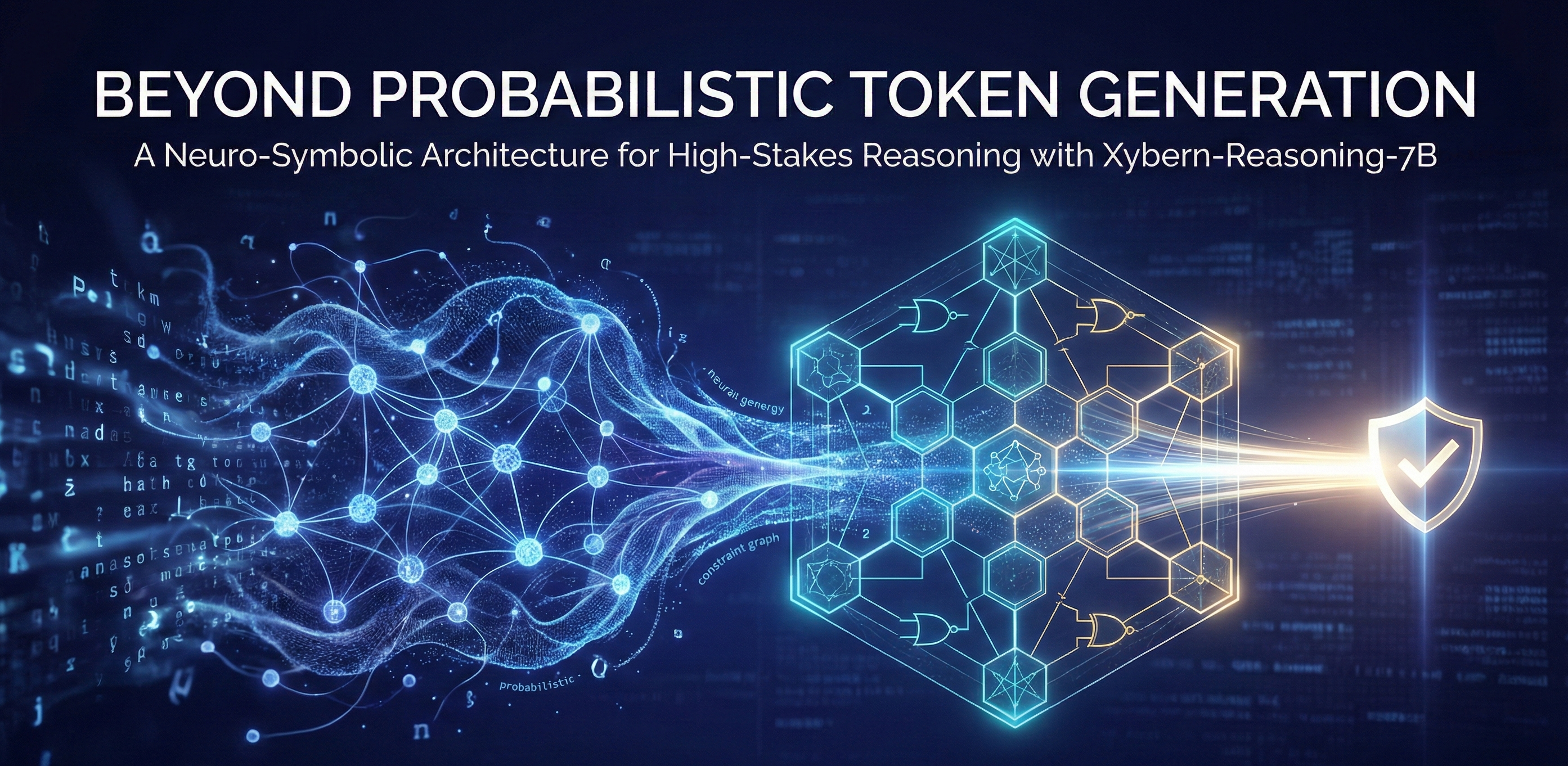
Beyond Probabilistic Token Generation
A Neuro-Symbolic Architecture for High-Stakes Reasoning with Xybern-Reasoning-7B
Abstract
Large Language Models (LLMs) have brought impressive fluency and broad problem-solving abilities. Yet in high-stakes domains—especially law and finance—purely neural, next-token predictors can exhibit brittle constraint handling, inconsistent multi-step reasoning, and limited guarantees around factual traceability and rule adherence. This article introduces Xybern-Reasoning-7B, a compact reasoning model designed to move beyond probabilistic token generation by coupling System 1 neural inference with a System 2 symbolic verification and constraint engine.
We present a neuro-symbolic architecture that (1) separates fast generative reasoning from slow, rule-bound checking, (2) incorporates explicit constraint graphs and deterministic validators, and (3) uses self-verification signals to improve reliability. We outline domain-agnostic mechanisms for constraint satisfaction, formal consistency checking, and audit-friendly reasoning traces. Finally, we define an evaluation framework for comparing Xybern-Reasoning-7B against generalist models on constraint-heavy tasks.
1. Motivation: Why “Beyond Probabilistic Token Generation”?
General-purpose LLMs excel at pattern completion across broad domains. But in law and finance, the cost of a single constraint violation can be catastrophic: an invalid clause, a noncompliant policy interpretation, incorrect treatment of precedence, or a misapplied risk rule can produce outcomes that are not merely wrong, but legally or financially unsafe.
While frontier models can appear to reason, their core objective remains statistical: maximize the likelihood of the next token given context. This creates three persistent friction points for high-stakes reasoning:
- Constraint fragility: Even when constraints are stated clearly, generalist models may violate them under long contexts, adversarial prompts, or ambiguous language.
- Inconsistent multi-step logic: The model may produce locally plausible steps that conflict globally.
- Weak verifiability: Outputs can be hard to audit; correct-looking answers may not be defensible under formal rules.
Xybern-Reasoning-7B addresses these limitations via structured reasoning, constraint awareness, and verification-first generation.
2. The Statistical Limitations of Standard LLMs in Law and Finance
2.1 Why next-token prediction struggles with formal constraints
In legal and financial settings, reasoning is frequently:
- Rule-governed (statutes, regulations, policy rules, accounting standards).
- Hierarchical (precedence, exceptions, jurisdictional scope).
- Compositional (contracts with nested conditions, covenants, triggers).
- Audit-driven (the why matters almost as much as the what).
A purely neural model is asked to emulate these properties without hard guarantees. The result is a system that may be excellent at language but unreliable at formal compliance.
2.2 CTO-relevant failure modes
The highest-impact risks in real deployments are not simple factual mistakes. They include:
- Silent constraint violations (the answer reads smoothly while breaching requirements).
- Overconfident hallucinations (fabricated citations, regulations, or financial rules).
- Partial compliance (satisfying one constraint while missing others).
- Context drift (initial alignment erodes as reasoning continues).
These issues reflect architectural gaps, not merely data gaps. Xybern’s thesis is that reliable high-stakes reasoning requires a first-class System 2.
3. Architecture Overview
Xybern-Reasoning-7B is a neuro-symbolic hybrid designed to align two complementary modes of cognition:
- System 1 (Neural): fast, probabilistic generation of candidate reasoning paths.
- System 2 (Symbolic): slow, deterministic checking, constraint satisfaction, and self-verification.
3.1 High-level flow
- The user provides a query and optional constraints.
- System 1 generates multiple candidate reasoning paths.
- A symbolic interpreter builds a Constraint Graph from the prompt and rule sets.
- Deterministic validators check each candidate for satisfiability and rule compliance.
- The system returns the best validated answer or flags missing/conflicting constraints.
4. System 1 vs. System 2 Diagram
4.1 Conceptual architecture (ASCII)
                 ┌──────────────────────────────────────────┐
                 │              User Request                │
                 │  Question + Context + Constraints (opt.) │
                 └──────────────────────────────────────────┘
                                       │
                                       ▼
                 ┌──────────────────────────────────────────┐
                 │     Constraint Extractor / Interpreter   │
                 │  - parses explicit rules                 │
                 │  - detects implied constraints           │
                 │  - builds constraint schema              │
                 └──────────────────────────────────────────┘
                          │                       │
                          │                       ▼
                          │        ┌────────────────────────┐
                          │        │  System 2 (Symbolic)   │
                          │        │  Constraint Graph +    │
                          │        │  Validators            │
                          │        └────────────────────────┘
                          │                       ▲
                          ▼                       │
          ┌──────────────────────────────────────────────┐
          │             System 1 (Neural)                │
          │       Xybern-Reasoning-7B Core               │
          │  - multi-path reasoning generation           │
          │  - uncertainty-aware decoding                │
          │  - self-critique proposals                   │
          └──────────────────────────────────────────────┘
                          │
         ┌────────────────┼────────────────┐
         │                │                │
         ▼                ▼                ▼
  Candidate A      Candidate B      Candidate C
         │                │                │
         └──────────┬─────┴─────┬──────────┘
                    ▼           ▼
           ┌──────────────────────────┐
           │ System 2 Verification    │
           │ - constraint satisfaction│
           │ - formal consistency     │
           │ - rule precedence checks │
           └──────────────────────────┘
                    │
                    ▼
           ┌──────────────────────────┐
           │  Best Validated Answer   │
           │  + Audit Trace (optional)│
           └──────────────────────────┘
4.2 Mermaid diagram (paper-ready)
flowchart TD
  U[User Request\nQuestion + Context + Constraints] --> CE[Constraint Extractor / Interpreter]
  CE --> S1[System 1: Xybern-Reasoning-7B\nMulti-path Candidate Generation]
  CE --> S2[System 2: Symbolic Engine\nConstraint Graph + Validators]

  S1 --> A[Candidate A]
  S1 --> B[Candidate B]
  S1 --> C[Candidate C]

  A --> V[System 2 Verification]
  B --> V
  C --> V

  S2 --> V
  V --> O[Best Validated Answer\n+ Optional Audit Trace]
5. Core Design Principles
5.1 Separation of generation and validation
System 1 is optimized for speed and breadth of hypothesis generation. System 2 is optimized for formal correctness. Fluent reasoning is treated as a hypothesis to be verified, not as proof of validity.
5.2 Constraint Graph as a first-class artifact
Instead of treating constraints as plain text, Xybern externalizes them into a structured intermediate representation:
- Nodes: rules, obligations, entities, numerical bounds.
- Edges: precedence, dependencies, exclusivity.
- Validators: satisfiability checks, exception-handling logic, required-field enforcement.
5.3 Multi-path reasoning + consensus
System 1 generates diverse candidates under different decoding regimes. System 2 selects based on:
- constraint satisfaction,
- global logical consistency,
- minimal assumption penalties,
- uncertainty markers.
5.4 Auditability by design
For high-stakes workflows, outputs can include a compact audit trace:
- extracted constraints,
- triggered rules,
- rejection reasons for alternative candidates,
- confidence and risk flags.
6. Implementation Overview (Model + Engine)
6.1 Xybern-Reasoning-7B neural core
Key traits of the 7B core:
- reasoning-tuned instruction stack emphasizing constraint alignment,
- self-verification prompting,
- uncertainty-aware decoding for dense-constraint environments.
The compact scale supports cost-efficient deployment while System 2 supplies stronger formal guarantees.
6.2 System 2 symbolic layer
A modular verification layer can include:
- domain-agnostic constraint parsing,
- organization-owned rule libraries,
-
deterministic validators for:
-
numerical bounds,
- clause structure,
- precedence and exception logic,
- compliance checklists.
This layer can be updated independently from the neural core to adapt rapidly to policy/regulatory changes.
7. Benchmarking: Constraint Satisfaction Evaluation
7.1 What we measure
We focus on constraint-heavy evaluation rather than broad “general intelligence”.
- Constraint Satisfaction Rate (CSR): outputs satisfying all explicit constraints.
- Partial Compliance Score (PCS): weighted score when only some constraints are met.
- Consistency Under Length (CUL): CSR across increasing prompt lengths.
- Audit Trace Quality (ATQ): rubric-based usefulness of the trace.
7.2 Task families
- Structured contract editing.
- Regulatory Q&A with explicit rule injection.
- Financial policy reasoning with abstracted thresholds and approval trees.
- Synthetic SAT-style textual constraints.
7.3 Benchmark results table (template)
This document does not fabricate results. Replace placeholders with measured values.
| Model | Params | CSR ↑ | PCS ↑ | CUL ↑ | Notes |
|---|---|---|---|---|---|
| Xybern-Reasoning-7B (S1+S2) | 7B | TBD | TBD | TBD | Neuro-symbolic with deterministic validation |
| Xybern-Reasoning-7B (S1-only ablation) | 7B | TBD | TBD | TBD | Quantifies System 2 contribution |
| Generalist Model A | TBD | TBD | TBD | TBD | Baseline general-purpose LLM |
| Generalist Model B | TBD | TBD | TBD | TBD | Stronger baseline |
7.4 Recommended protocol
- Use matched prompts with explicit rule blocks.
- Evaluate with and without distractor text.
- Include adversarial attempts to override constraints.
- Report mean/variance across multiple seeds.
- Provide ablations: no System 2, fewer candidates, reduced graph complexity.
8. Why This Is Different From GPT-4-Class Generalists
For CTO-level evaluation, the core contrast is architectural:
- Generalist LLMs: centralized neural reasoning; constraints handled implicitly inside generation.
- Xybern-Reasoning-7B: distributed reasoning with explicit constraint representation and deterministic validation.
Practical advantages:
- improved reliability in rule-bound tasks,
- faster domain updates via symbolic rule changes without retraining,
- audit-friendly adoption with formal traces,
- cost-effective reasoning from a compact base model plus System 2 safeguards.
9. Limitations and Future Work
Remaining risks include:
- constraint extraction errors,
- rule conflicts within real policy sets,
- domain-specific edge cases requiring specialized validators.
Planned extensions:
- richer deontic logic for obligations and permissions,
- automatic conflict-resolution proposals,
- hybrid retrieval of authoritative rule sources,
- continuous evaluation against evolving policy corpora.
10. Conclusion
Xybern-Reasoning-7B operationalizes a pragmatic hypothesis: high-stakes reasoning needs more than fluent token prediction. A neuro-symbolic blend of fast neural generation and slow, formal verification can reduce silent constraint violations, increase auditability, and make a compact model viable for enterprise-grade legal and financial reasoning.
This architecture reframes the evaluation question from “How big is the model?” to “How reliable is the reasoning system?”
Appendix A: Suggested Figure Captions
- System 1 vs System 2 architecture for Xybern-Reasoning-7B.
- Constraint Graph construction and validation lifecycle.
- CSR vs prompt length for Xybern-Reasoning-7B compared with generalist baselines.
Appendix B: Minimal Constraint Graph Schema (illustrative)
{
  "constraints": [
    {
      "id": "C1",
      "type": "numerical_bound",
      "target": "risk_score",
      "operator": "<=",
      "value": 0.25,
      "priority": 1
    },
    {
      "id": "C2",
      "type": "required_clause",
      "target": "contract",
      "value": "termination_notice_period",
      "priority": 2
    },
    {
      "id": "C3",
      "type": "precedence",
      "target": "rule_set",
      "value": ["jurisdictional_statutes", "company_policy"],
      "priority": 0
    }
  ]
}
Appendix C: One-Page CTO Summary
Xybern-Reasoning-7B is a neuro-symbolic reasoning system built for high-stakes constraint satisfaction. Unlike standard LLMs that implicitly handle rules within a purely neural generator, Xybern externalizes constraints into a formal graph and uses deterministic validators to accept, reject, or refine neural candidate answers. This yields stronger compliance behavior, clearer auditability, and faster domain adaptation without requiring a massive generalist model.
References (starter bibliography)
- Kahneman, D. Thinking, Fast and Slow (System 1 / System 2 framing).
- Wei, J. et al. Chain-of-thought prompting elicits reasoning in large language models.
- Wang, X. et al. Self-consistency improves chain of thought reasoning in language models.
- Cobbe, K. et al. Training verifiers to solve math word problems.
- Lewis, P. et al. Retrieval-augmented generation for knowledge-intensive NLP tasks.
- Gao, L. et al. PAL: Program-aided language models.
- Yao, S. et al. ReAct: Synergizing reasoning and acting in language models.
- OpenAI. GPT-4 Technical Report.
- Mialon, G. et al. Augmented language models: A survey.
- Lin, S. et al. TruthfulQA.
- Bommarito, M. J., & Katz, D. M. Mathematical approaches to legal corpora.
- Evans, R. et al. Neuro-symbolic AI survey.